

Sukanya Samriddhi Yojana Calculator 2026
Estimate your SSY maturity amount, total contribution, interest earned and year-wise growth using a clean Sukanya Samriddhi Yojana calculator built for girl child savings planning.
Big Future
Deposit Period
Interest Rate
21 Years
Backed Scheme
Calculate SSY maturity
Enter the yearly deposit amount, age details and interest rate to estimate maturity value, total contribution and year-wise balance growth.
Important SSY calculator disclaimer
SimpleEMI is an independent informational calculator website. This page does not open Sukanya Samriddhi Yojana accounts, collect deposits, provide government services or offer personalised financial advice.
The result shown by this calculator is an estimate based on the yearly deposit, account age, interest rate and deposit timing entered by the user. Actual maturity value may vary if official SSY interest rates, scheme rules or deposit behaviour change in future periods.
SSY planning highlights
These highlights turn the calculator output into a more readable planning summary for users who want a quick understanding of maturity value, contribution size and long-term growth.
Estimated maturity value based on the deposit amount, timeline and interest rate entered in the calculator.
Total amount contributed during the deposit period considered by the calculator.
Estimated growth generated through compounding over the full account timeline.
Expected age at maturity based on the current age and account opening age selected above.
Visual guide to SSY growth
Add these three supporting visuals to make the calculator page more engaging, easier to understand and stronger for user retention.
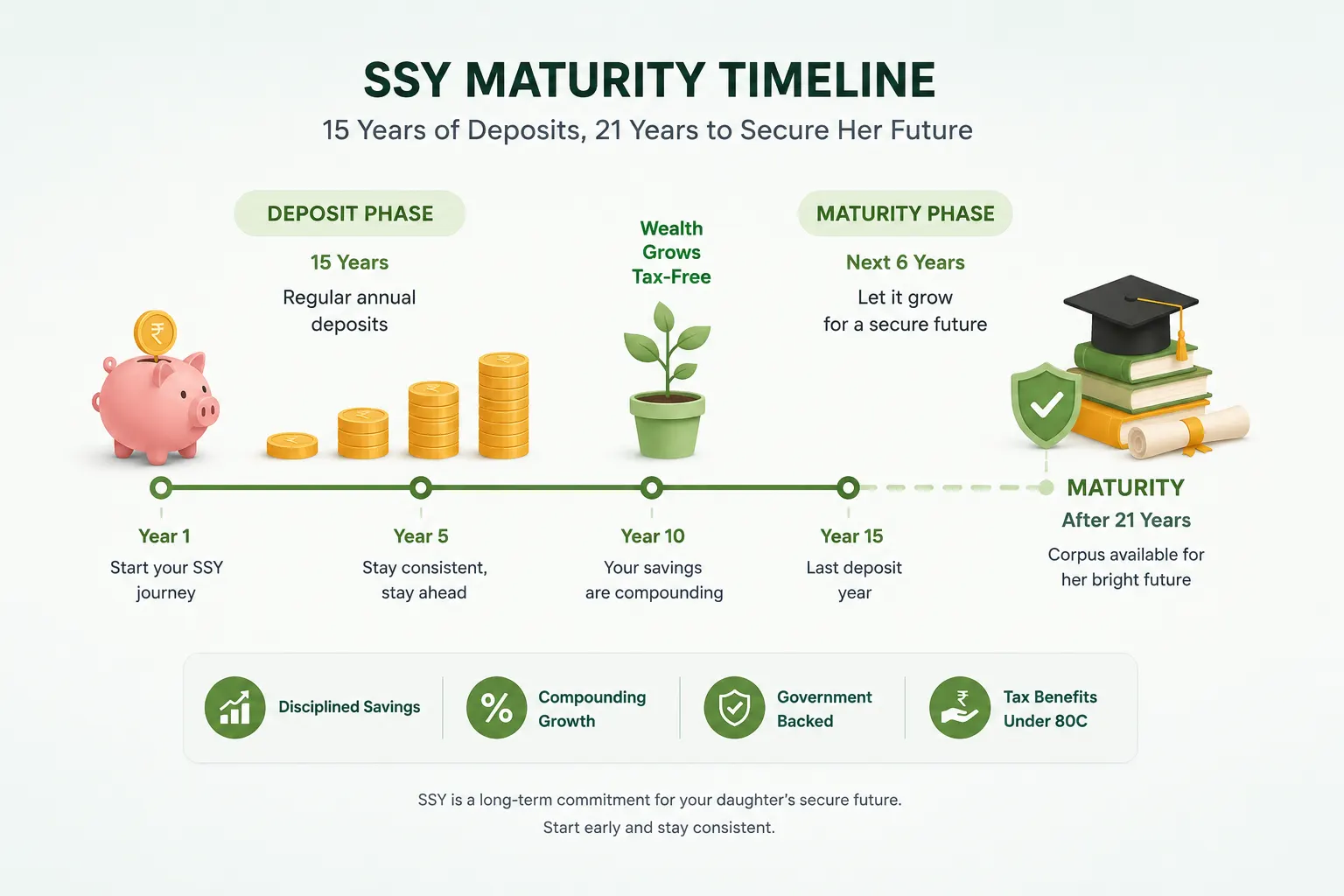
Deposit phase vs maturity phase
Use this visual to explain why deposits continue for a limited period while the account continues to grow until maturity.
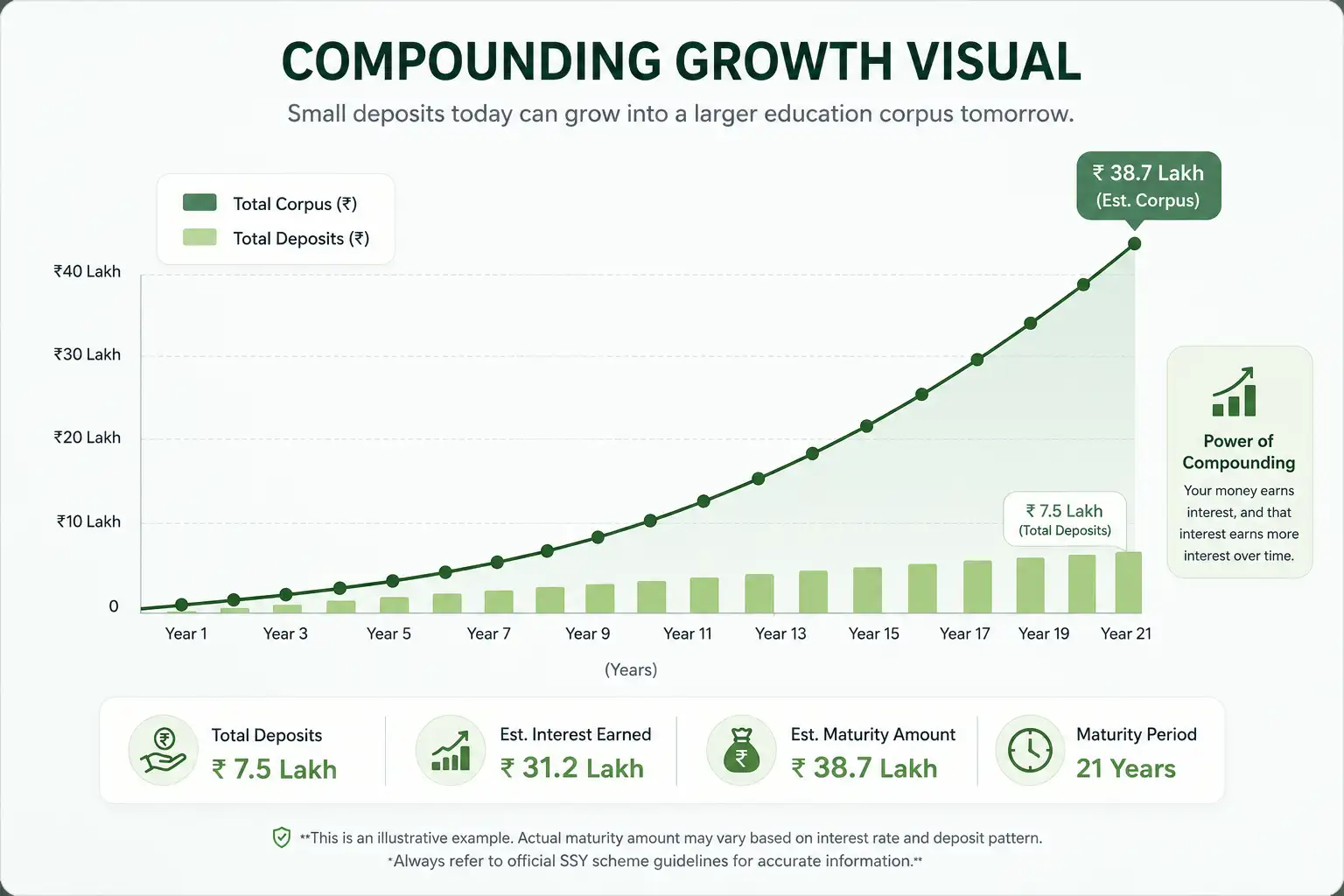
How interest builds over time
This visual helps users understand why long-term saving consistency can create a larger maturity estimate.

Real-life planning context
Use this section to connect the calculator result with long-term education and future planning decisions.
Deposit vs interest chart
This chart gives a quick visual view of how much of the final corpus comes from yearly deposits and how much comes from interest growth over time.
Maturity timeline view
This timeline shows how much of the account journey is still in the deposit phase and how much is left in the maturity-only growth phase.
SSY year-wise growth table
This table shows how the balance may grow year by year based on the deposit amount, assumed interest rate and the remaining timeline until maturity.
| Year | Age | Opening balance | Deposit | Interest | Closing balance |
|---|---|---|---|---|---|
| Calculation will appear here. | |||||
SSY yearly deposit comparison
This comparison chart helps users test multiple yearly contribution amounts and see how the estimated maturity value changes.
How to read your SSY result
A useful calculator should explain the meaning of each output clearly. This table helps users understand the maturity estimate in a more practical way.
| Result shown | What it means | Why it helps |
|---|---|---|
| Estimated maturity amount | The projected closing value of the account at maturity based on the current inputs. | Helps users understand the likely end value of their long-term savings plan. |
| Total deposit | The full amount added by the user during the deposit period used in the calculation. | Shows how much of the final corpus comes from actual contributions. |
| Interest earned | The difference between projected maturity amount and total deposits. | Shows how compounding contributes to long-term growth over time. |
| Years remaining to maturity | The remaining timeline considered by the calculator until the account reaches maturity. | Useful for planning how long the money may stay invested. |
| Deposit and interest split | A simple visual view of contribution portion versus growth portion. | Makes the result easier to understand without reading too many numbers. |
How this calculator works
This Sukanya Samriddhi Yojana calculator estimates maturity value using the annual deposit amount entered by the user, the current age of the girl child, the age when the account was opened and the yearly interest rate selected for the estimate.
It assumes a fixed yearly deposit during the eligible contribution period and then applies interest for the remaining years until maturity. The result gives a simplified estimate to help users understand long-term savings growth.
How this SSY calculator is prepared
This calculator is created for educational use by the SimpleEMI editorial workflow to help users estimate Sukanya Samriddhi Yojana maturity values in a simple, transparent way.
The page is structured to explain the calculator output, deposit assumptions, timeline and common interpretation mistakes instead of showing only one final number.
Calculation method used
- Uses the annual deposit amount entered by the user within the allowed yearly contribution range.
- Considers the age at account opening and current age to estimate remaining deposit years and maturity timeline.
- Applies the selected annual interest rate as a simplified yearly compounding assumption for planning purposes.
- Shows total deposit, estimated interest and year-wise balance so users can review the estimate clearly.
Sukanya Samriddhi Yojana at a glance
Many users want a quick rule summary before they trust the calculator result. This section gives a clearer overview of the key SSY points that usually matter most while planning yearly deposits and estimating maturity value.
This page uses 8.2% as the default annual rate for estimation. Users can still edit the rate field to test a different assumption.
The calculator keeps deposit values within the standard yearly range generally used for SSY planning.
The deposit phase is shorter than the full maturity timeline, so the calculator separates contribution years from remaining growth years.
The maturity estimate is projected over a 21-year account period from the date of account opening.
Sukanya Samriddhi Yojana rules at a glance
This section summarises the key rule-related points users often search for while using an SSY maturity calculator.
| Topic | Simple explanation |
|---|---|
| Who the account is for | The scheme is designed around an account opened in the name of a girl child, subject to the age limit used in the rules. |
| Age limit at opening | This page is structured around the usual rule that the account may be opened up to the age of 10 years. |
| One account per girl child | This is one of the most common checks users look for while understanding SSY basics. |
| Where it may be opened | Users commonly check whether the scheme is available through post offices and authorised banks, so that point is stated clearly here. |
| Higher-education withdrawal context | Many visitors also want to know whether withdrawal support exists for higher-education-related expenses of the account holder. |
SSY interest rate history
A short SSY interest rate history helps users understand why maturity values should always be treated as estimates rather than fixed future returns.
| Period | Interest rate | Why this matters |
|---|---|---|
| 01 Apr 2020 to 31 Mar 2023 | 7.6% | Shows that the scheme rate has changed in the past, so future maturity value should always be treated as an estimate. |
| 01 Apr 2023 to 31 Dec 2023 | 8.0% | Useful for users comparing older and current SSY rate levels while reviewing long-term assumptions. |
| 01 Jan 2024 to 30 Jun 2026 | 8.2% | This is the current rate band reflected in the default estimate used on this page. |
How much should you invest yearly in SSY?
The right annual contribution depends on long-term affordability, not only on the final maturity amount. This guide helps users think about contribution levels in a more practical way.
Lower contribution approach
A yearly contribution such as ₹10,000 or ₹25,000 may suit families who want disciplined long-term savings without putting pressure on annual cash flow. This approach is often useful when consistency matters more than chasing the highest possible maturity value.
Higher contribution approach
A yearly contribution such as ₹50,000 or ₹1,00,000 can significantly improve the final maturity amount because the effect of compounding becomes more visible over time. This approach suits users who want stronger long-term accumulation and can maintain the higher contribution regularly.
How parents use this SSY calculator in real planning
This section connects the result with practical planning decisions instead of treating the page as only a one-number calculator.
Education planning use case
Some families use the SSY calculator to estimate what a long-term yearly contribution could build by the time higher-education-related needs arise. Even though the final value is still an estimate, the calculator helps create a more structured starting point for planning.
Long-term savings discipline use case
Other users treat SSY as a disciplined annual savings habit. In those cases, the calculator becomes useful not just for maturity value but also for understanding how compounding rewards consistency over a long timeline.
Who usually uses an SSY calculator
Visitors use a Sukanya Samriddhi calculator for different reasons. Some want a quick maturity estimate, while others want to compare yearly deposit options before starting a long-term savings plan.
Parents planning yearly contributions
Many parents use an SSY calculator to test what a fixed yearly contribution could build over time. It becomes easier to compare different deposit amounts when the maturity result, total deposit and interest earned are shown together.
- Useful when testing ₹10,000, ₹25,000, ₹50,000 or higher annual contributions.
- Helps users move from guesswork to a more practical estimate.
- Makes long-term planning easier to explain within the family.
Users comparing multiple long-term options
Some users check SSY along with PPF, FD, RD or SIP pages to understand how different savings paths look over a long time horizon. In that situation, a section-wise page with more written guidance becomes much more useful than a calculator that shows only one number.
- Helpful for comparing scheme-based and market-linked saving styles.
- Useful when users want a clearer first-level understanding before reading official scheme rules in detail.
- Improves page usefulness for both beginners and comparison-focused users.
Common SSY calculation mistakes
These are some of the most common mistakes people make while estimating SSY maturity value. Avoiding these assumptions can make the final result easier to interpret and more useful for planning.
| Common mistake | What users often assume | Better way to think about it |
|---|---|---|
| Expecting the same interest rate forever | Users often assume the current rate will remain unchanged for the whole tenure. | The calculator gives a clean estimate, but real maturity value may differ if official SSY rates change over time. |
| Ignoring the difference between deposit years and maturity years | Some people assume deposits continue for the entire maturity timeline. | The contribution period and the maturity period are different, so both should be read separately. |
| Looking only at the final maturity amount | The final number gets all the attention. | It is better to review total deposit, interest earned and year-wise growth together. |
| Using an unrealistic annual deposit amount | Some users test a number that may look attractive but is difficult to sustain each year. | A more useful estimate comes from entering a contribution amount that feels practical over the long term. |
Why people use an SSY calculator
A good Sukanya Samriddhi Yojana calculator should do more than show a maturity number. It should help users understand how yearly deposits, interest growth and account timeline work together so the final estimate feels practical and easy to read.
- To estimate how much a fixed yearly deposit could grow by maturity.
- To understand the difference between total deposits and projected interest earned.
- To compare a small deposit, medium deposit and higher deposit planning approach.
- To read scheme-related guidance in a structured format instead of checking multiple pages separately.
Frequently asked questions
What is a Sukanya Samriddhi Yojana calculator?
It is a calculator that estimates the maturity value of an SSY account based on yearly deposit amount, interest rate and the account timeline.
Does this calculator show exact SSY returns?
No. It provides an estimate based on the values entered and the assumptions used on the page. Actual returns may differ if future rates change.
Can I change the interest rate in the calculator?
Yes. The default rate can be edited so users can test a different assumption and see how the maturity amount changes.
Does this page open an SSY account?
No. This page is only an informational calculator and does not provide account opening, deposit collection or advisory services.